
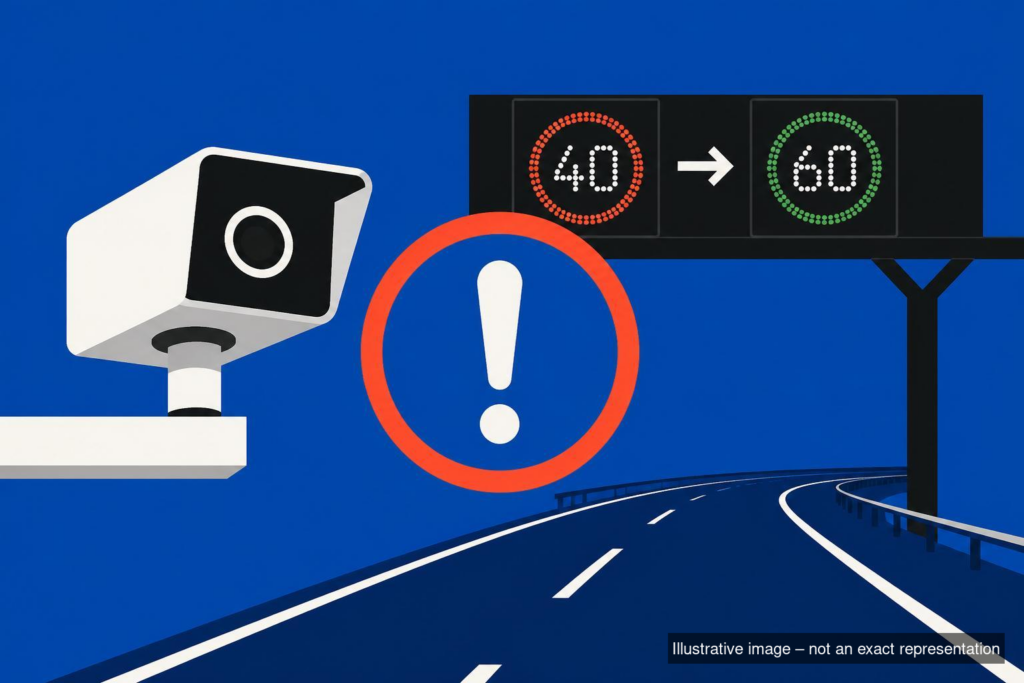
Transport Minister Highlights Camera Activation Issue
An self-reliant review has identified technical and organisational failures in the operation of some variable speed cameras on motorways and A roads. Transport operators and drivers should be aware that, while affected cameras are no longer being used for enforcement, variable speed limits remain in force and alternative enforcement measures continue.
Further Camera Activation Issue Identified
National Highways first disclosed in December 2025 that thousands of drivers may have been incorrectly fined because of a fault affecting variable speed cameras on certain A roads and motorways.
Following an independent investigation commissioned by the Department for Transport (DfT) in January, Transport Minister Justin Madders confirmed that further testing has identified a potential additional issue with how the cameras may activate in specific circumstances. The issue originates from the same 2019 system upgrade.
National Highways and the Home Office have undertaken extensive technical and operational testing of the relevant camera and enforcement systems. National Highways’ modelling indicates that the probability of the specific circumstances causing the further error is no more than 0. 1%.
Mr Madders stated that there is no real-world evidence that the newly identified issue has affected enforcement.
How The Original Fault Occurred
The independent review, conducted by DfT non-executive board member Tracy Westall, found that drivers could be incorrectly identified as speeding when variable speed limit signs changed several times within a short period.
The fault involved two systems used on smart motorways:
- MIDAS (Motorway Incident Detection and Automatic Signalling), which manages variable speed limits displayed on overhead gantries in response to traffic conditions.
- HADECS3X, the speed camera system used to enforce variable speed limits.
The systems did not always communicate correctly. HADECS3X had a delay of just over 17 seconds before recognising a change to the displayed speed limit. This delay was intended to prevent the system responding to temporary or unreliable changes.
However, where a speed limit changed and then changed back within that period, HADECS3X could continue to enforce the previous, lower limit even though drivers were shown a higher limit on the gantry. Consequently, motorists could be recorded as speeding despite complying with the displayed speed limit.
The issue came to light after a member of the public provided dashcam footage to Avon and Somerset Police. The footage identified a discrepancy between traffic management systems and enforcement cameras, which had resulted in a Notice of Intended Prosecution being issued incorrectly.
Scale Of The Issue And Enforcement Changes
The fault affected variable speed cameras on smart motorways, a section of the A14 between Huntingdon and Cambridge, and the A1 approach to the A14 junction.
Between 2021 and 2025, there were 2,650 erroneous camera activations involving 154 cameras across 22 police force areas.
The Home Office has revoked the camera system’s type approval status. This approval allows camera data to be more readily admitted as evidence in certain legal proceedings. The Home Office concluded that the issues could not be resolved satisfactorily within a reasonable timeframe.
National Highways is ending its contractual relationship with the camera supplier, Verra Mobility, for enforcement purposes and is considering further commercial and legal action.
Variable speed limits will continue to be used to manage road safety, traffic flow and congestion. National Highways has introduced additional traffic officer patrols at affected locations and is using existing CCTV, automatic number plate recognition (ANPR) cameras, stopped vehicle detection radar and emergency area monitoring to support compliance and safety.
Review Finds Governance And Communication Failures
The review concluded that the original technical fault was compounded by serious organisational shortcomings within National Highways. These included poor governance, inadequate escalation procedures, weak leadership and delayed communication with police forces.
Ms Westall found that, after National Highways became aware of the issue in January 2025, several opportunities for intervention and escalation were missed. The matter was initially treated as an isolated sensor fault, despite concerns raised by staff and technical specialists.
The review also found that no individual had clear duty for the entire enforcement system, and senior management did not understand the seriousness of the issue quickly enough. Police forces were not informed nationally until October 2025, and National Highways did not activate its crisis management procedures.
National Highways has accepted the review’s recommendations and has begun implementing improvements to its corporate governance, crisis management, data and technology management, and stakeholder engagement processes. The DfT will monitor progress and hold National Highways accountable through its existing sponsorship arrangements.
Mi Compliance Advice For Operators And Drivers
Operators should continue to remind drivers that variable speed limits are legally enforceable, even where changes are being made to camera enforcement arrangements. Drivers should always follow the speed limit displayed on overhead gantries and remain alert to changing traffic management instructions.
Transport businesses should also ensure that any Notices of Intended Prosecution are reviewed promptly, with relevant journey data, vehicle records and driver evidence retained where appropriate. For practical guidance on driver compliance, evidence management and road risk procedures, Contact Mi Compliance.
Source: Fleet News

0333 090 8899Office
07868 780254Call/Whatsapp
info@micompliance.co.ukEmail
178 CROW LANE, ROMFORD RM7 0ES
MiComplianceUK
Socials